Choose timezone
Your profile timezone:
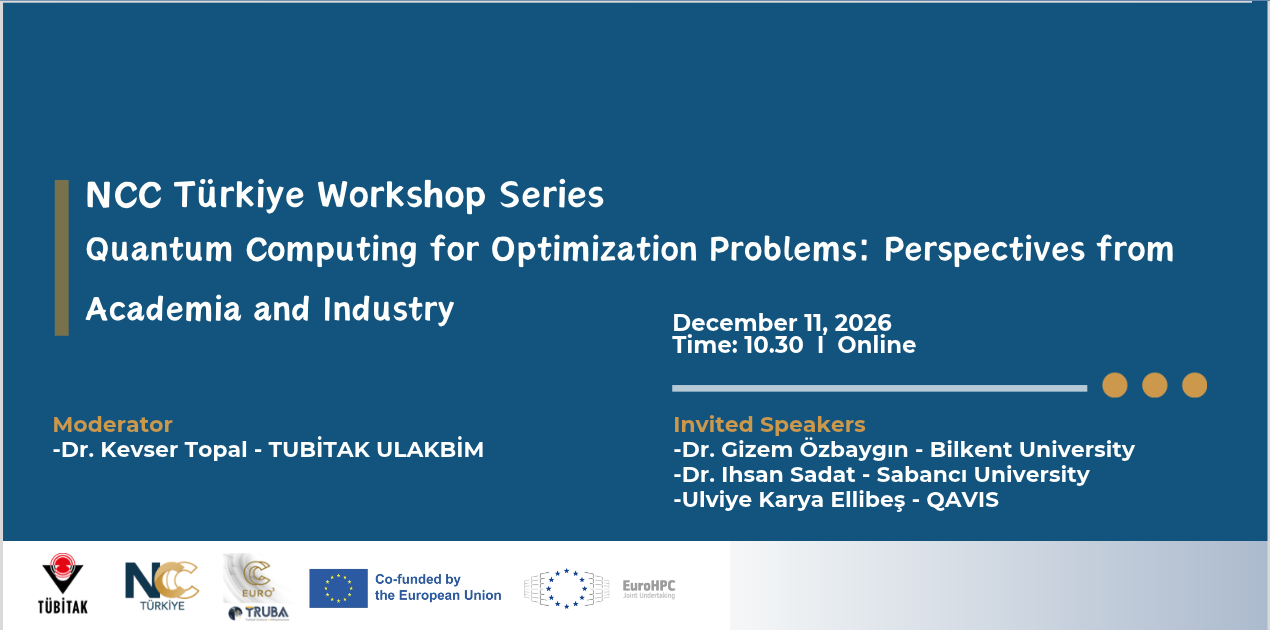
Date: December 11, 2026
Time: 10:30-13:00 (İstanbul, Türkiye GMT+3:00)
Event Type: Workshop
Format: Online (Zoom)
Topic: Quantum Computing for Optimization Problems: Perspectives from Academia and Industry
Overview:
This workshop aims to bring real-world optimization challenges from the industry to the forefront through concrete use cases, exploring how these problems are mathematically modeled, tackled with emerging quantum algorithms, and transformed into actionable research questions.
Participants will gain a comprehensive understanding of the quantum optimization landscape from two complementary perspectives:
The Academic Perspective: Discover the journey from classical mathematical programming formulations to Quantum Unconstrained Binary Optimization (QUBO) forms. The sessions will explore how these models are addressed using Quantum Annealing and the Quantum Approximate Optimization Algorithm (QAOA), while candidly discussing the potential and limitations of today's quantum hardware.
The Industry Perspective: Learn where the real difficulties lie when applying quantum methods to industry problems—from handling incomplete data and encoding disappearing constraints, to the costs of quantum resources and the challenges of testing ideas without compromising sensitive data.
Agenda: Please refer to the timetable for more information. Please be aware that the times given are in Istanbul, Türkiye (GMT+3:00).
11 December 2026
| Time | Session | Speaker |
| 10:30-10:40 | Welcome and introduction to the workshop | Dr. Kevser Topal (TUBITAK ULAKBIM-TRUBA) |
| 10:40-11:10 |
Industry talk: Where Quantum Optimization Really Pays Off: Lessons from the Operations Room |
Ulviye Karya Ellibeş (QAVIS) |
| 11:10-11:40 | Academic talk: Bridging Classical and Quantum Optimization for Solving Combinatorial Optimization Problems | Dr. Gizem Özbaygın (Bilkent University) |
| 11:40-11:50 | Break | |
| 11:50-12:20 | Academic talk: Optimization in Logistics and Transportation Networks: Classical Algorithms and Quantum Opportunities | Dr. İhsan Sadati (Sabanci University) |
| 12:20-12:50 | Open discussions | |
| 12:50-13:00 | Closing Remarks |
Level: Intermediate
Language: English
Duration: 2.5 hours
Target Audience: Academia (possible BSc., MSc, PhD students, Postdoctoral Researchers), Industry
Target Audience: Basic understanding of optimization, a conceptual understanding of fundamental quantum computing principles (qubits, superposition), and a general awareness of the difference between gate-based quantum computing and quantum annealing.
About the instructors:
Gizem Özbaygın is a faculty member in the Industrial Engineering Department at Bilkent University. Prior to joining Bilkent, she was a faculty member in the Industrial Engineering Program at Sabancı University from 2017 to 2024. Gizem also spent a year in Canada as a Senior Operations Research Scientist at 1QBit, a quantum computing software company based in Vancouver, and subsequently collaborated with their R&D team in different roles for over a year. She is a member of the INFORMS Quantum Computing and Operations Research (QCOR) steering committee (https://connect.informs.org/quantum/home) and is leading the Quantum Operations Research (QORE) lab (https://gizem-ozbaygin.github.io/qore/) which she founded at Bilkent. Her research interests include the use of quantum computing and physics-inspired alternatives to classical computing to tackle complex optimization problems.
İhsan Sadati is an Assistant Professor of Industrial Engineering in the Faculty of Engineering and Natural Sciences at Sabancı University, Türkiye. He received his Ph.D. in Industrial Engineering and Operations Management from Koç University in 2018. His research focuses on operations research, combinatorial optimization, vehicle routing, logistics network optimization, and sustainable transportation systems. His work involves the development of mathematical programming models, decomposition methods, and metaheuristic algorithms for complex logistics problems. His recent research also explores electric vehicle routing, dynamic charging systems, and emerging computational approaches to optimization.
Ulviye Karya Ellibeş is the co-founder and CEO of Qavis, which builds decision-support software for planning and scheduling under disruption and evaluates classical, quantum-inspired, and quantum methods on industrial optimization problems. She studied Computer Engineering at Maltepe University and worked in machine learning and technical project management before founding Qavis, and received Microsoft 1st place award from QC Hack'22 by Stanford and Yale University. She led Qavis through the Creative Destruction Lab Quantum cohort in Montreal. At Qavis, she works with industrial teams to make emerging technologies deliver real, measurable impact.
Moderator: Dr. Kevser Topal
Application Due: December 9, 2026
Contact:
This course is offered free of charge
Notes:
Registration based on the principle of "first come – first served"
Please cancel your registration if you won't be able to attend so that others may attend.
-------
Disclaimer
Only participants who live and work in EuroHPC JU participating countries (such as Türkiye) are eligible to attend the event.
(https://eurohpc-ju.europa.eu/about/discover-eurohpc-ju_en)
Only official institutional email addresses (e.g., your company’s corporate email address or a university email address with an .edu domain) are accepted for registration. Personal or generic email addresses (such as Gmail, Hotmail, Yahoo, etc.) will not be accepted.
------
You can follow us on LinkedIn. Don’t forget to subscribe to our YouTube channel!
- LinkedIN: https://www.linkedin.com/company/eurocc-turkey
- YouTube: https://www.youtube.com/c/EuroCCTurkey
Acknowledgements
EuroCC 3 has received funding from the European High-Performance Computing Joint Undertaking (JU) under Grant Agreement No. 101306701. The JU receives support from the European Union‘s Digital Europe Programme and Germany, Albania, Austria, Belgium, Bosnia and Herzegovina, Bulgaria, Croatia, Cyprus, Czechia, Denmark, Estonia, Finland, France, Greece, Hungary, Iceland, Ireland, Italy, Latvia, Lithuania, Luxembourg, Malta, Montenegro, the Netherlands, North Macedonia, Norway, Poland, Portugal, Romania, Serbia, Slovakia, Slovenia, Spain, Sweden, Türkiye, and Kosovo. Funded by the European Union. Views and opinions expressed are however those of the author(s) only and do not necessarily reflect those of the European Union or EuroHPC Joint Undertaking. Neither the European Union nor the EuroHPC Joint Undertaking can be held responsible for them. HPC in Europe is the umbrella brand uniting Europe's high-performance computing initiatives across 36+ countries.